The short answer
This leads to an important traditional concept:
整体观念 — zhěngtǐ guānniàn — the holistic view.
“Whole person” is a useful way into the idea, but the traditional concept has its own structure.
Many people first encounter Traditional Chinese Medicine (TCM) through acupuncture, herbal medicine, cupping or gua sha.
That can make TCM look like a collection of treatment methods.
But before asking how to treat a problem, the basic theory of Traditional Chinese Medicine begins with a more fundamental question:
How should we understand a person?
Imagine you have not slept well for several nights.
The change may not stop at sleep. You may feel more irritable, find it harder to concentrate, feel tired during the day or notice a change in appetite.
These things can be studied separately. TCM also asks another question:
What else is connected to this?
This leads to an important traditional concept:
整体观念 — zhěngtǐ guānniàn — the holistic view.
“Whole person” is a useful way into the idea, but the traditional concept has its own structure.
1. The person is a whole
In TCM theory, different parts of the body are not understood as completely isolated from one another.
Later, we will talk about the Zang-Fu organs, Qi, Blood, Body Fluids and meridians. These are understood through their relationships, not as separate boxes.
There is also an important phrase here:
形神一体 — xíng shén yī tǐ.
For now, xing, 形, can be understood as the physical body.
Shen, 神, is a richer concept that deserves its own explanation later. At this stage, it is enough to know that it includes aspects of mental, emotional and inner life.
The idea is not that every physical problem is psychological, or that every emotional problem comes from the body.
It is simpler:
The body and inner life are not treated as completely unrelated parts of a person.
So when TCM looks at one part, it keeps the whole person in view.
2. The person and nature are related
A person does not live in an unchanging environment.
Day and night are different. Winter and summer are different.
Temperature, light, season and daily rhythm all shape the conditions in which we live.
This is one reason TCM also considers the relationship between the person and the natural world.
Traditional Chinese thought often uses the phrase:
天人合一 — tiān rén hé yī.
It can become a much more philosophical idea, but the basic point here is simple:
Human beings live within nature, not outside it.
3. The person and society are related
People also live within families, work, relationships, responsibilities and social environments.
These things should not be turned directly into a diagnosis or a TCM pattern.
But they are still part of the life of the person we are trying to understand.
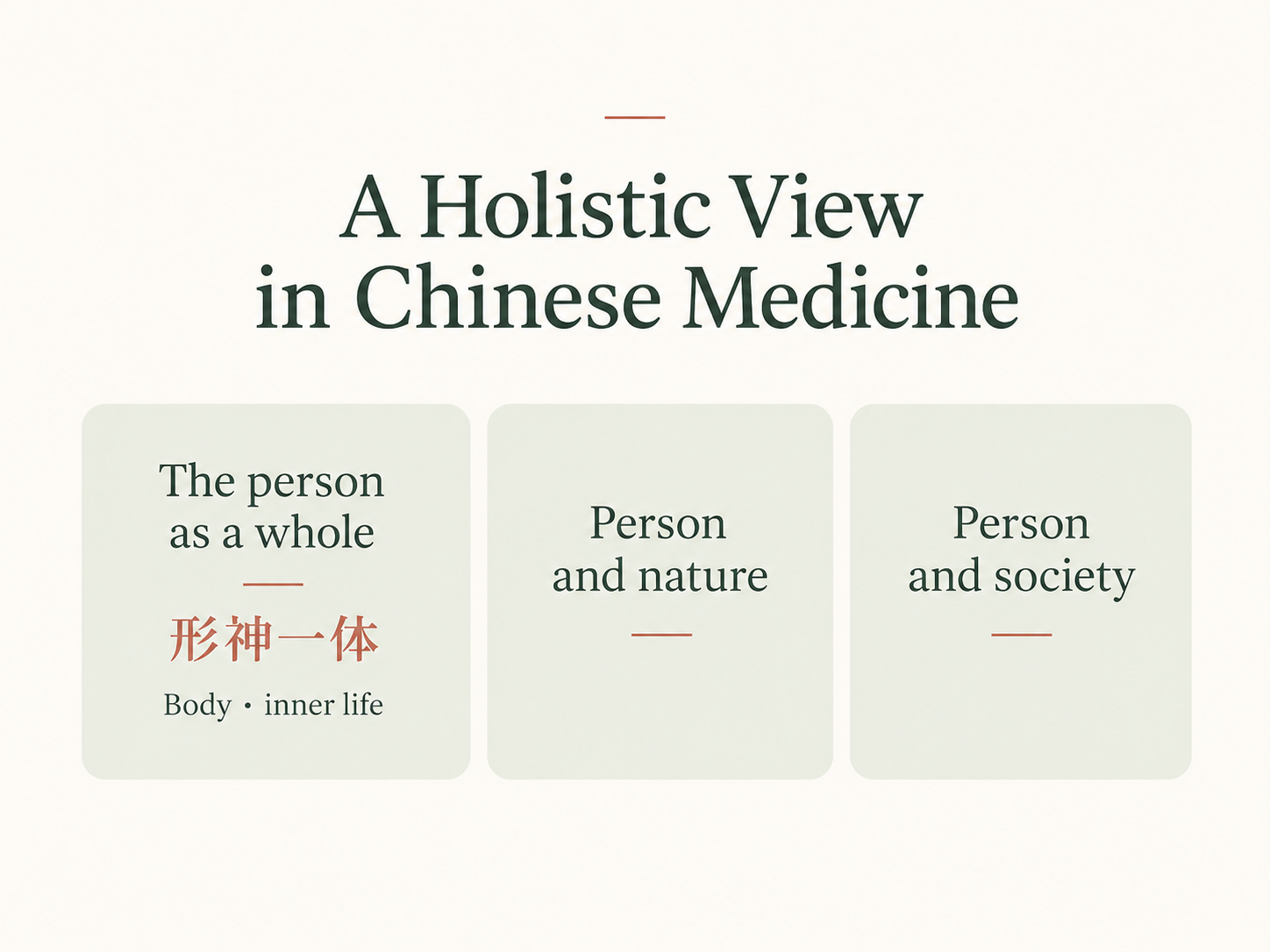
So TCM's holistic view can be remembered in three layers:
The person is a whole.
The person is related to nature.
The person is related to society.
And within the first layer, one important idea is:
形神一体 — the unity of xing and shen.
The holistic view does not mean that everything causes everything.
It changes something more basic: how we pay attention.
When something happens, we can ask:
What is happening here?
And then:
What else is connected to it?
That way of thinking leads naturally to the next concept.
Once we begin to notice relationships, differences and change, we need a language for describing them.
What is rising and what is falling?
What is warmer and what is cooler?
What is moving and what is still?
How can the same thing be described differently when the point of comparison changes?
Yin and Yang are one of the basic languages TCM uses to describe these relationships and changes.
So before we ask how Yin and Yang change, we first need to ask:
What is Yin? What is Yang?
Follow the connections
Yin & Yang
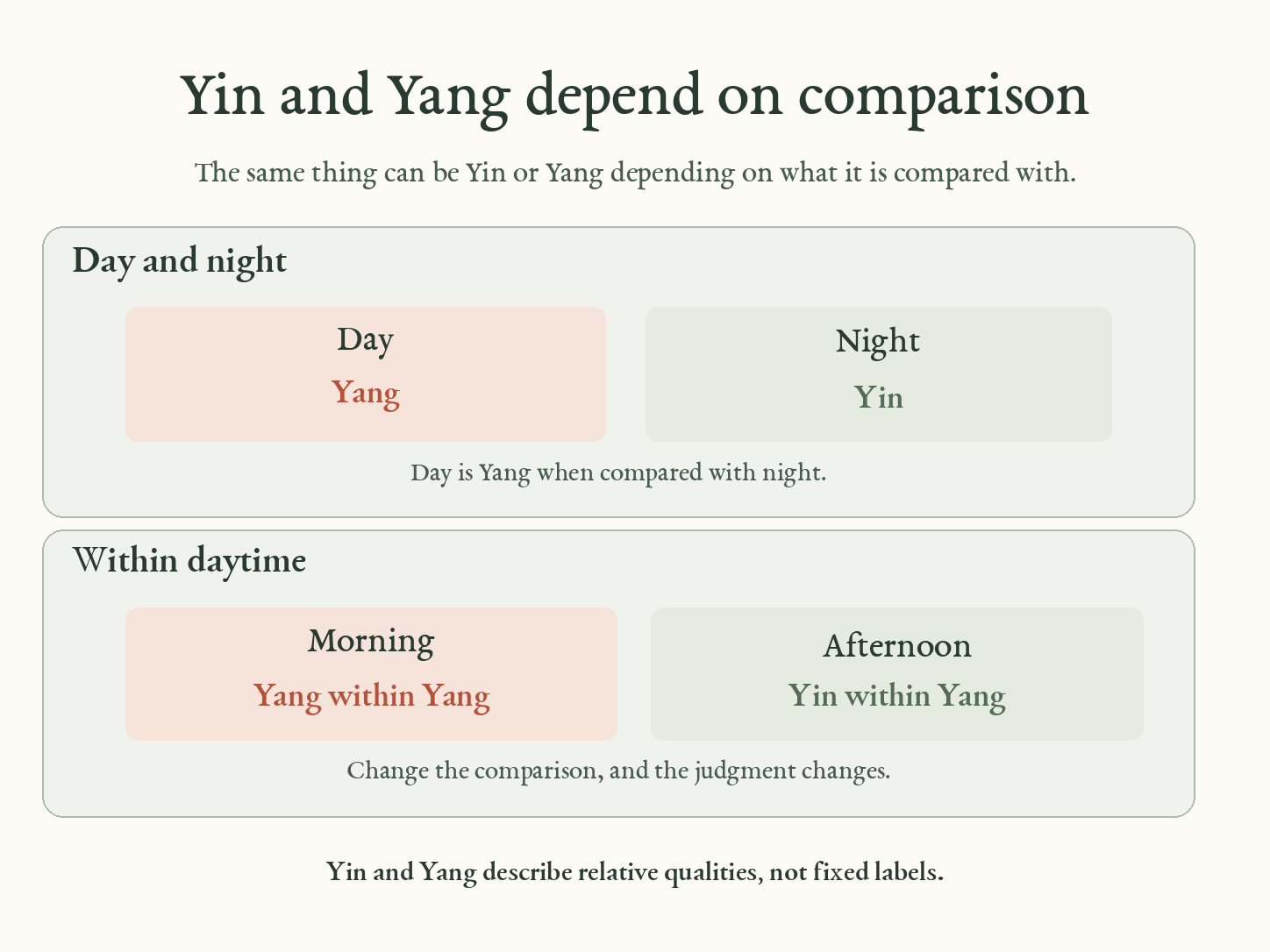
Yin and Yang Meaning: What Yin and Yang Actually Mean in Traditional Chinese Medicine
Learn what Yin and Yang mean in Traditional Chinese Medicine, why their qualities are relative, and how comparison changes the way they are understood.
Read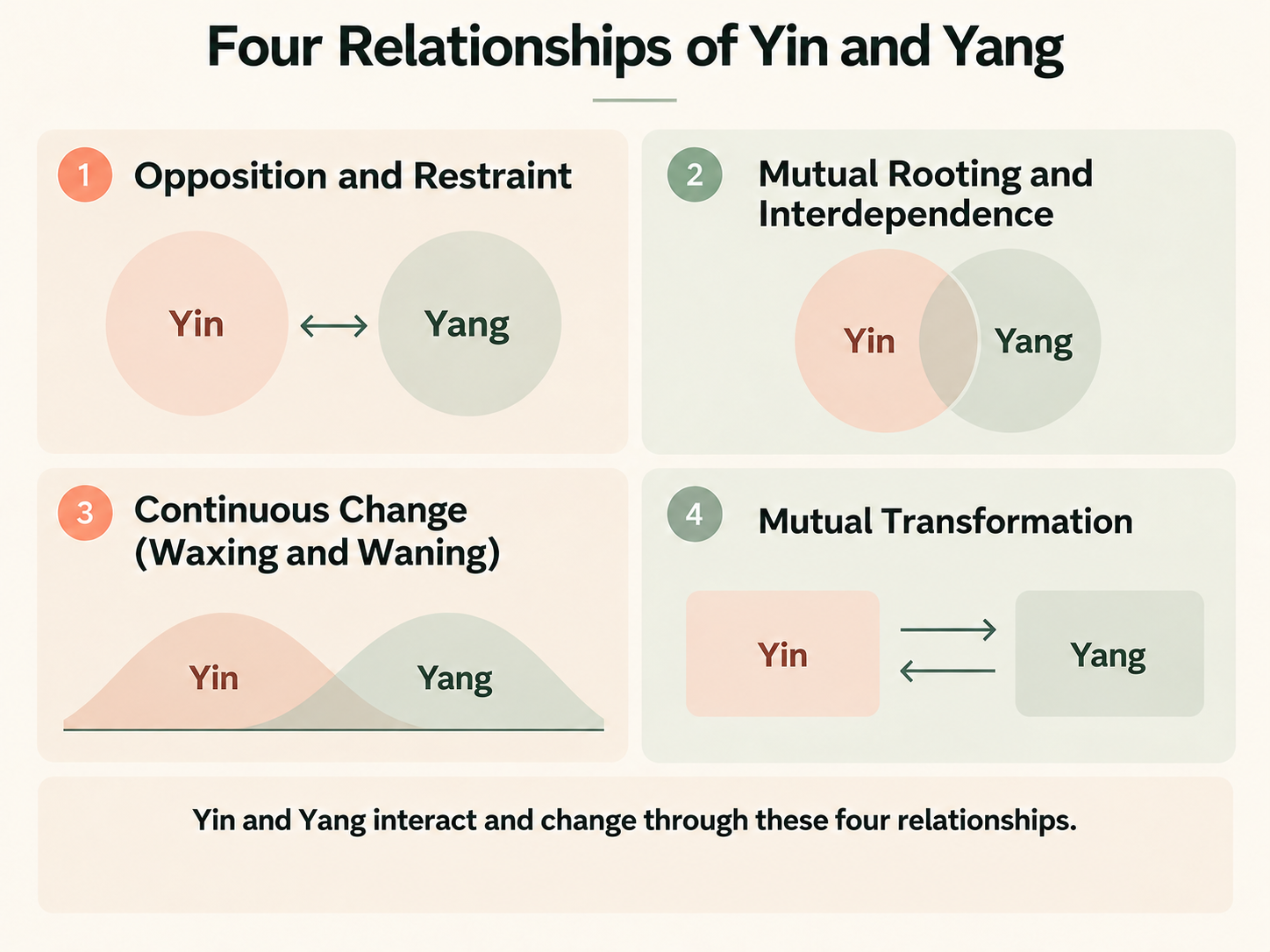
Yin & Yang
How Yin and Yang Relate: Four Core Relationships in Traditional Chinese Medicine
Understand four core Yin–Yang relationships in Traditional Chinese Medicine: opposition and restraint, interdependence, waxing and waning, and transformation.
ReadSources & notes
Where this explanation begins
- National Health Commission / State Council Information Office · Traditional Chinese Medicine in China
Used for the holistic view in Traditional Chinese Medicine.
- The Chinese Medicine Hospital of Hong Kong · The Essence of Traditional Chinese Medicine Culture
Used for the traditional holistic view and cultural context.
For educational reading. This article does not provide individual diagnosis or treatment and is not a substitute for qualified professional care. Read the disclaimer.
Continue reading
Yin and Yang Meaning: What Yin and Yang Actually Mean in Traditional Chinese Medicine
The next question in the Chinese Medical Worldview & Holism reading path.
Back to Chinese Medical Worldview & Holism