The short answer
But in Traditional Chinese Medicine (TCM), Yin and Yang are not simply labels. They are a way of describing relationships.
At the most basic level, the two sides must be:
related to each other, while also showing contrast or opposition.
When many people hear “Yin and Yang,” the first thing that comes to mind is the familiar black-and-white symbol.
That can make Yin and Yang look like two fixed categories:
this is Yin, and that is Yang.
But in Traditional Chinese Medicine (TCM), Yin and Yang are not simply labels. They are a way of describing relationships.
What kind of relationship can be described in terms of Yin and Yang?
At the most basic level, the two sides must be:
related to each other, while also showing contrast or opposition.
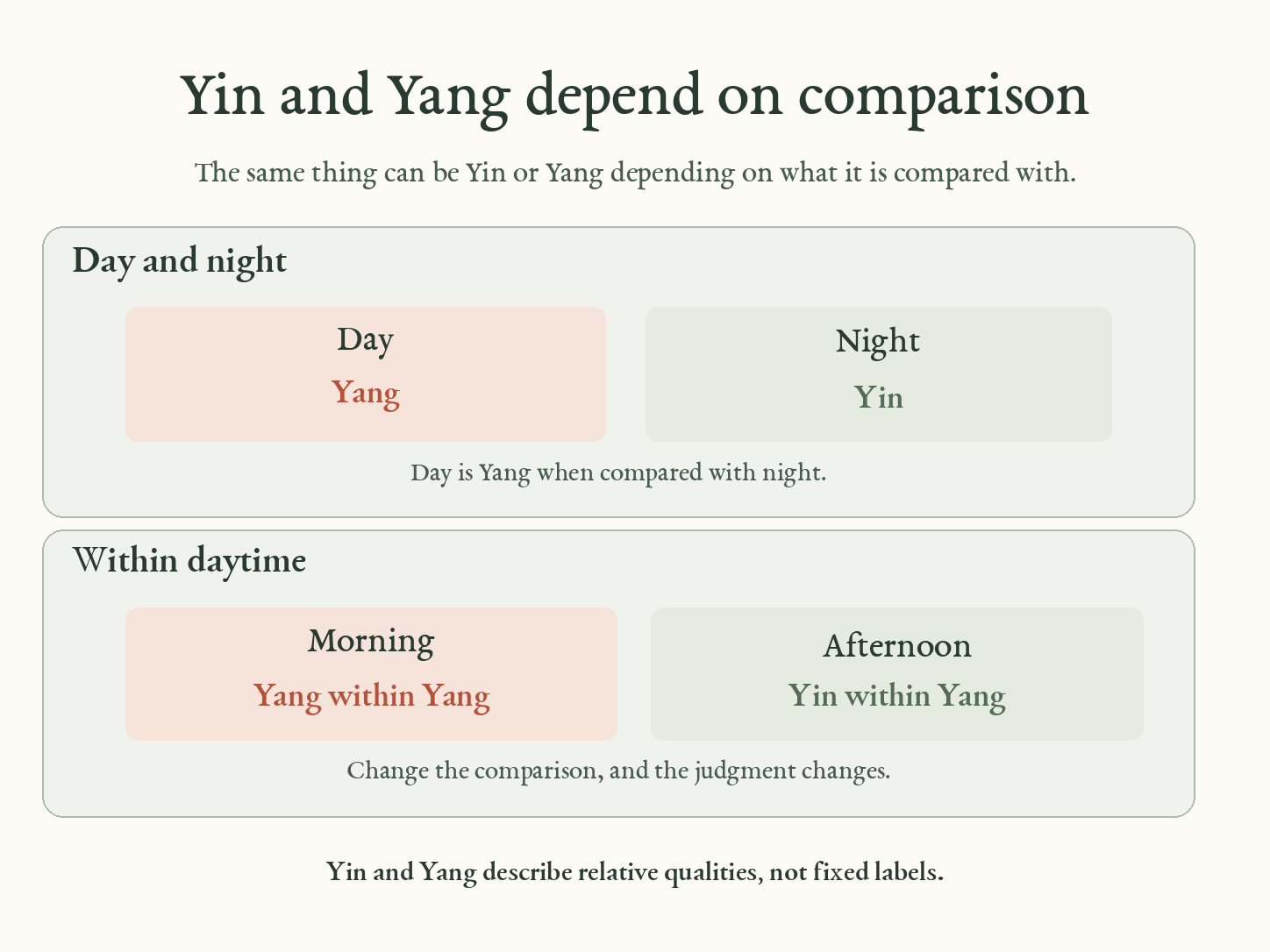
Take day and night.
They belong to the same daily cycle, so they are related. But they also differ clearly: one is bright and generally more active, while the other is dark and relatively quieter.
In this comparison, day is classified as Yang and night as Yin.
The important point is not simply to memorize:
day = Yang
night = Yin
The more useful question is:
Why can they be compared in terms of Yin and Yang at all?
Because Yin and Yang are not judged in isolation.
You need to know:
What is being compared with what?
Now consider a more interesting example.
Is the afternoon Yin or Yang?
Compared with night, the afternoon is part of daytime, so it belongs to Yang.
But if we compare morning and afternoon within the daytime, the answer becomes more specific.
In the morning, the sun is rising.
In the afternoon, the sun is moving toward sunset.
So within daytime, which is Yang as a whole:
the morning can be described as Yang within Yang,
while the afternoon can be described as Yin within Yang.
The afternoon has not suddenly “become Yin.”
What changed was the comparison.
This shows one of the most important features of Yin and Yang:
Yin and Yang are relative.
That is why learning Yin and Yang is not just about memorizing a chart of what belongs to Yin and what belongs to Yang.
The better questions are:
What is it being compared with?
Which aspect are we comparing?
At what level are we making the comparison?
This is also why many different qualities can be described in Yin–Yang terms.
For example:
movement and stillness,
upward and downward,
light and dark,
warm and cold.
In general, movement, upward direction, brightness and warmth tend toward Yang.
Relative stillness, downward direction, darkness and cold tend toward Yin.
But again, these are not fixed labels outside a specific comparison.
Yin and Yang describe relative qualities.
This is also why Yin and Yang should not be understood as “good” and “bad.”
Yang is not automatically better.
Yin is not automatically worse.
They describe different qualities within a relationship.
So if you want one simple sentence to remember what Yin and Yang mean, start here:
Yin and Yang are a way of describing related things or phenomena that show relative and contrasting qualities.
But this only answers the first question:
What are Yin and Yang?
It does not yet tell us what happens between them.
Yin and Yang can restrain each other.
They can depend on each other.
One may increase while the other decreases.
They may also increase or decrease together.
And under certain conditions, one may transform into the other.
That is where the relationships between Yin and Yang really begin.
In the next article, we will ask:
What kinds of relationships exist between Yin and Yang?
For now, remember three things:
Yin and Yang are not fixed labels.
They must be understood through relationship and comparison.
They describe relative qualities, not good and bad.
Follow the connections
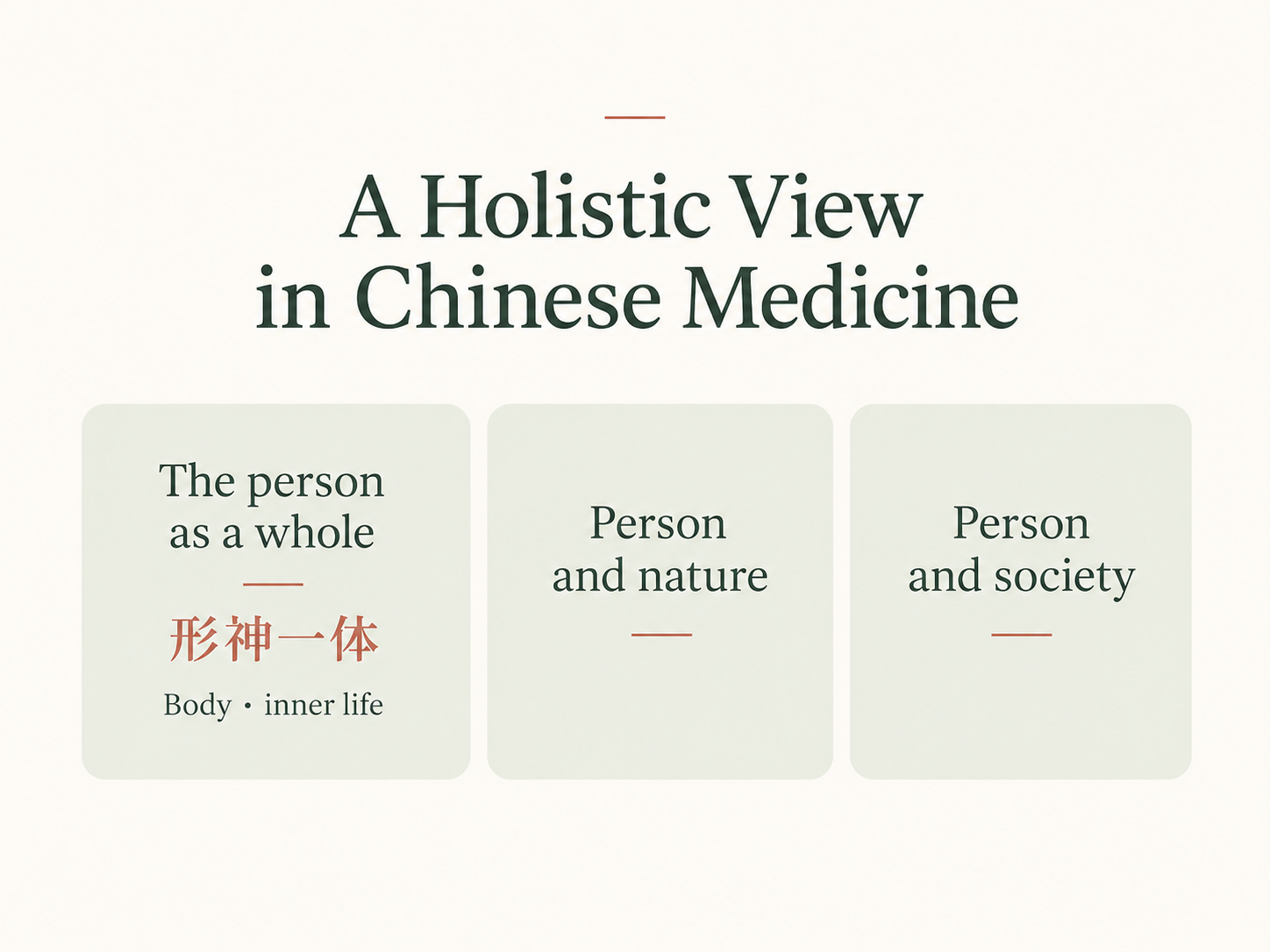
Chinese Medical Worldview & Holism
What Is Traditional Chinese Medicine? Start With the Whole Person
Learn how Traditional Chinese Medicine begins with a holistic view of the person, connecting the body, inner life, natural environment and social world.
Read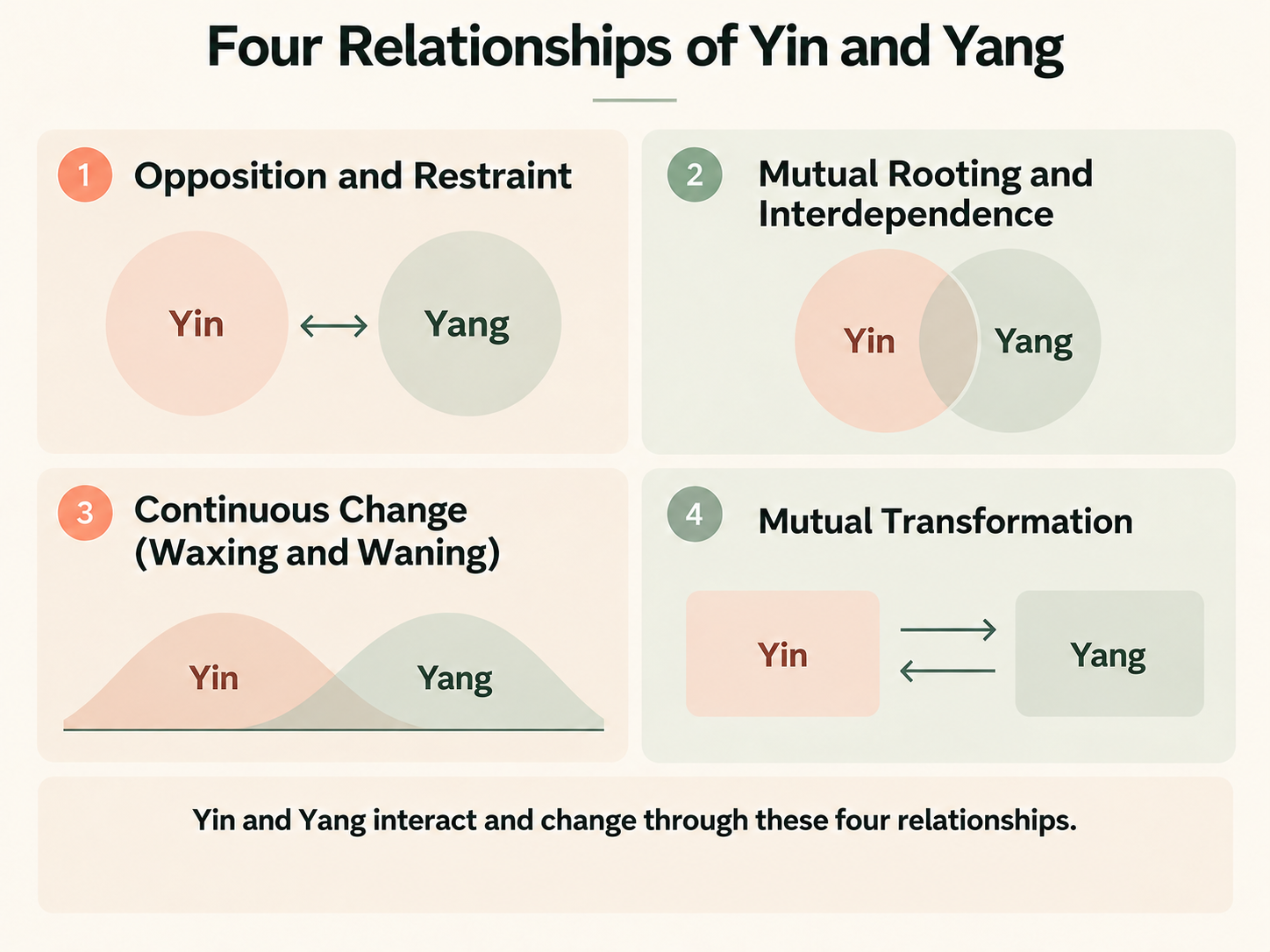
Yin & Yang
How Yin and Yang Relate: Four Core Relationships in Traditional Chinese Medicine
Understand four core Yin–Yang relationships in Traditional Chinese Medicine: opposition and restraint, interdependence, waxing and waning, and transformation.
ReadSources & notes
Where this explanation begins
- World Health Organization · WHO International Standard Terminologies on Traditional Chinese Medicine
Used for standard Yin–Yang terminology in Traditional Chinese Medicine.
- The Chinese Medicine Hospital of Hong Kong · Yin-Yang and Four Seasons
Used for Yin–Yang comparison and traditional seasonal context.
For educational reading. This article does not provide individual diagnosis or treatment and is not a substitute for qualified professional care. Read the disclaimer.
Continue reading
How Yin and Yang Relate: Four Core Relationships in Traditional Chinese Medicine
The next question in the Yin & Yang reading path.
Back to Yin & Yang