
The short answer
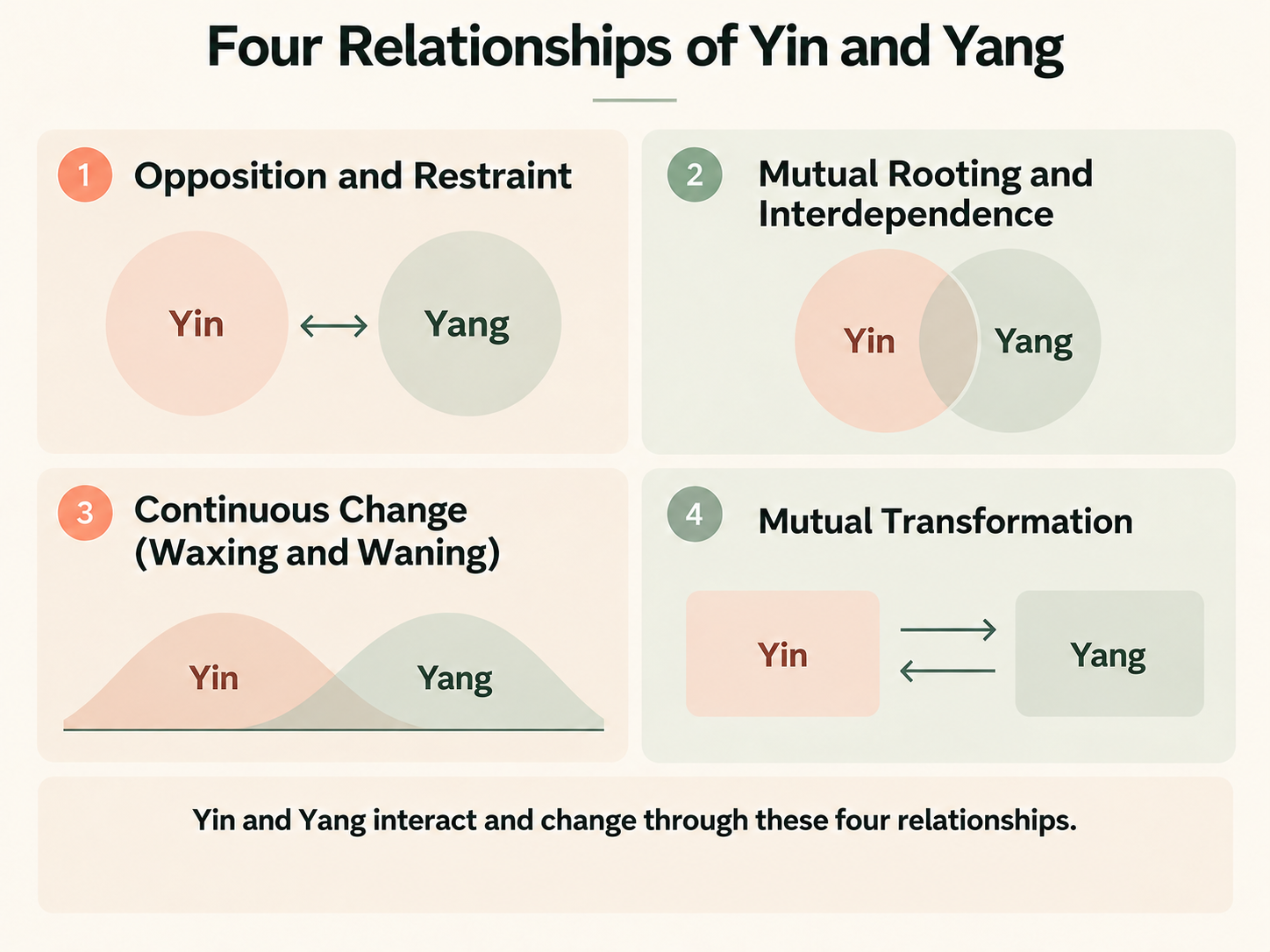
For beginners, four relationships are especially useful to understand:
opposition and restraint, mutual rooting and interdependence, waxing and waning, and transformation.
In the previous article, we saw that Yin and Yang are not fixed labels.
They have to be understood through relationship and comparison.
That leads to the next question:
If Yin and Yang exist in relation to each other, what happens between them?
For beginners, four relationships are especially useful to understand:
opposition and restraint, mutual rooting and interdependence, waxing and waning, and transformation.
In simpler language:
Opposition and restraint: each side can limit the other.
Mutual rooting and interdependence: each side depends on the other.
Waxing and waning: the amount of Yin or Yang changes.
Transformation: the quality itself changes.
1. Opposition and restraint
Because Yin and Yang describe contrasting qualities, they can restrain each other.
A simple way to understand this is:
when one side becomes stronger, it can limit the other.
“Restraint” does not mean that one side must eliminate the other.
In Traditional Chinese Medicine, a relatively stable state can result from the two sides continually limiting each other.
This is one way to understand the traditional phrase 阴平阳秘 — yīn píng yáng mì.
The point is not that Yin and Yang stop changing.
It is that both remain present, while neither is allowed to develop without limit.
That is opposition and restraint.
2. Mutual rooting and interdependence
But Yin and Yang do not only restrain each other.
They also depend on each other.
Traditional Chinese Medicine describes this as:
互根互用 — hù gēn hù yòng.
The simplest way to understand it is:
neither side can exist completely independently of the other.
A traditional phrase expresses this idea:
孤阴不生,孤阳不长 — isolated Yin cannot generate, isolated Yang cannot grow.
Interdependence also means that when one side is weakened, the other may be affected as well.
So opposition and interdependence are not contradictory.
Yin and Yang can:
limit each other while also depending on each other.
3. Waxing and waning
Because Yin and Yang both restrain and depend on each other, their relative amounts do not stay fixed.
They increase and decrease.
Traditional Chinese Medicine describes this as the waxing and waning of Yin and Yang.
There are two basic patterns.
The first is:
one increases while the other decreases.
For example, Yin may increase while Yang decreases, or Yang may increase while Yin decreases.
This is often called mutual waxing and waning or one waxing as the other wanes.
It more clearly reflects opposition and restraint:
as one side becomes stronger, the other is limited.
The second pattern is:
both increase together, or both decrease together.
This more clearly reflects mutual rooting and interdependence:
because the two sides depend on each other, changes in one may affect the other in the same direction.
A useful way to remember the distinction is:
one rises while the other falls — think opposition and restraint.
both rise or fall together — think mutual rooting and interdependence.
4. Transformation
Transformation is easy to confuse with waxing and waning.
The simplest way to separate them is to ask:
Has only the amount changed, or has the quality itself changed?
If something has only increased or decreased, that is still waxing and waning.
If, under certain conditions, a Yin quality changes into a Yang quality, or a Yang quality changes into a Yin quality, that is transformation.
So:
waxing and waning are about degree.
transformation is about a change in quality.
There is one more important point:
transformation does not happen automatically.
Yin does not simply turn into Yang because enough time has passed.
Yang does not automatically become Yin just because it keeps increasing.
Traditional Chinese Medicine describes transformation as something that may occur under certain conditions.
Put the four relationships together:
Opposition and restraint: the two sides limit each other.
Mutual rooting and interdependence: the two sides depend on each other.
Waxing and waning: their relative amounts change.
Transformation: the quality changes, under certain conditions.
Waxing and waning often reflects the first two relationships:
when one rises and the other falls, opposition and restraint are more visible;
when both rise or fall together, mutual rooting and interdependence are more visible.
And the key difference between waxing and waning and transformation is simple:
waxing and waning changes the degree; transformation changes the quality.
Follow the connections
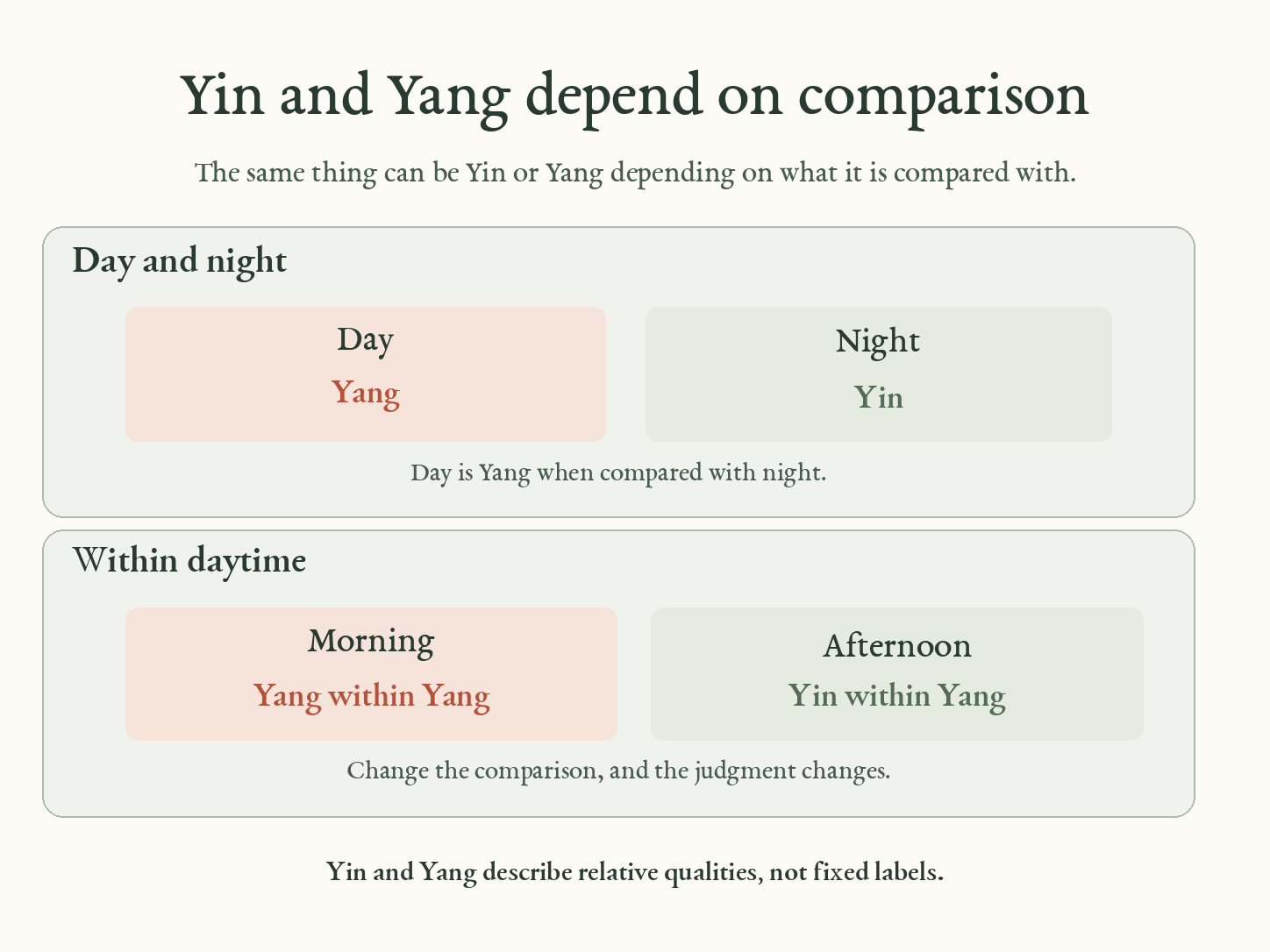
Yin & Yang
Yin and Yang Meaning: What Yin and Yang Actually Mean in Traditional Chinese Medicine
Learn what Yin and Yang mean in Traditional Chinese Medicine, why their qualities are relative, and how comparison changes the way they are understood.
Read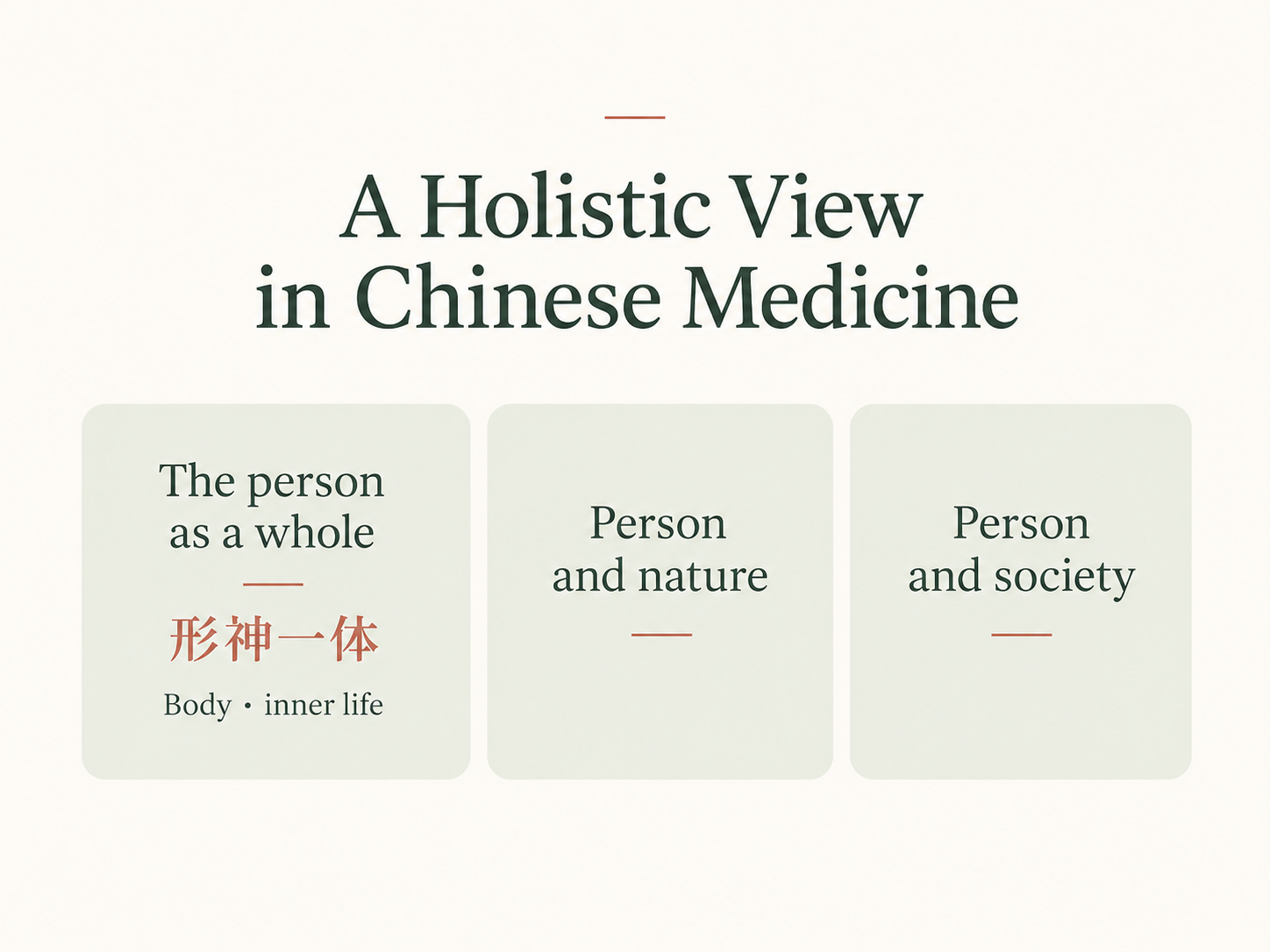
Chinese Medical Worldview & Holism
What Is Traditional Chinese Medicine? Start With the Whole Person
Learn how Traditional Chinese Medicine begins with a holistic view of the person, connecting the body, inner life, natural environment and social world.
ReadSources & notes
Where this explanation begins
- World Health Organization · WHO International Standard Terminologies on Traditional Chinese Medicine
Used for standard Yin–Yang relationship terminology in Traditional Chinese Medicine.
- The Chinese Medicine Hospital of Hong Kong · Yin-Yang and Four Seasons
Used for introductory Yin–Yang relationships and traditional seasonal context.
For educational reading. This article does not provide individual diagnosis or treatment and is not a substitute for qualified professional care. Read the disclaimer.
Continue reading
Five Elements or Five Phases? What Wu Xing Means in Traditional Chinese Medicine
The next question in the Yin & Yang reading path.
Back to Yin & Yang