When you first see the five words Wood, Fire, Earth, Metal and Water, it is easy to picture five physical things: a piece of wood, a flame, soil, metal and water.
But that is not what Wu Xing means in the theory of Traditional Chinese Medicine.
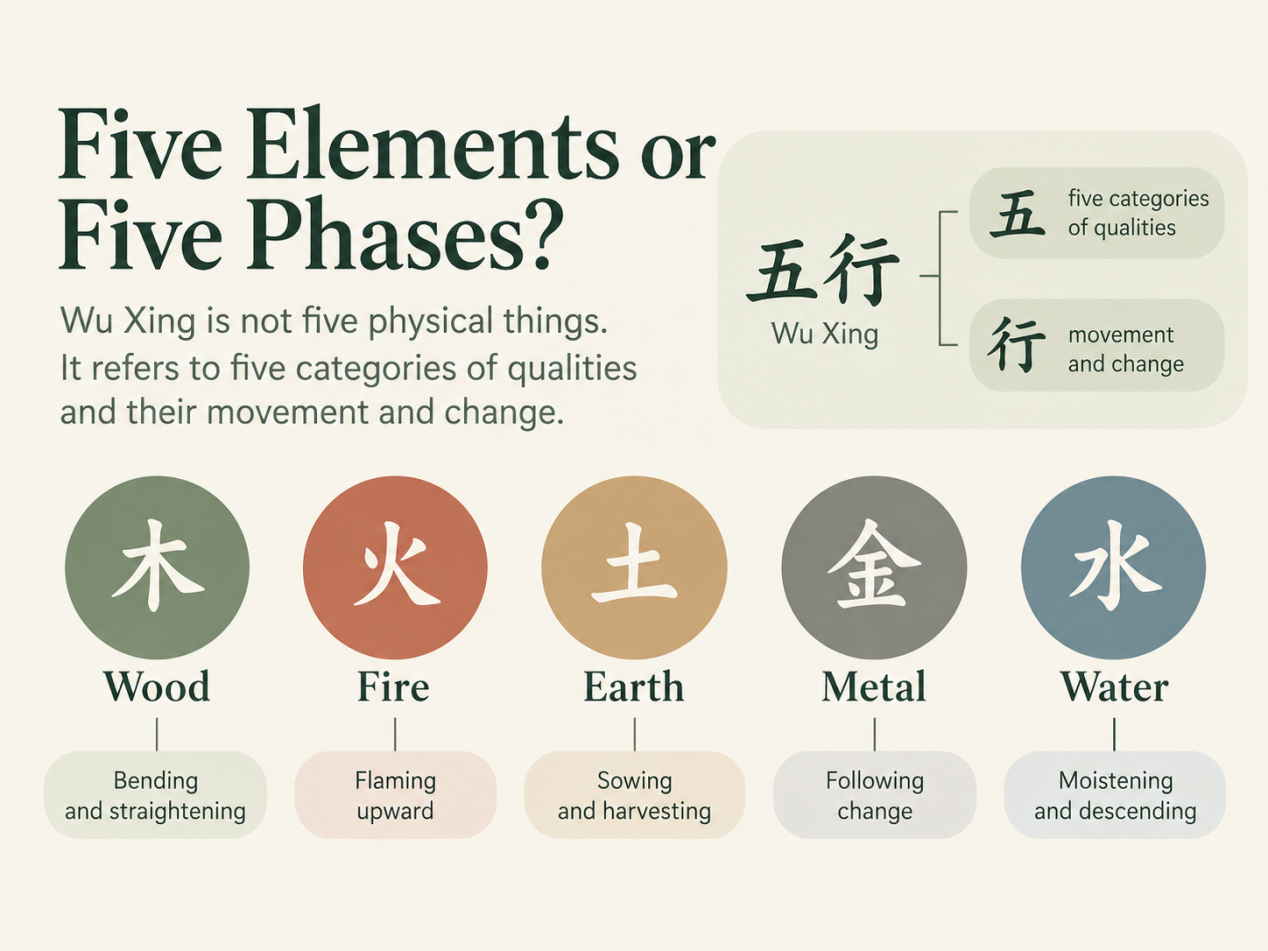
Basic Theory of Traditional Chinese Medicine defines Wu Xing as five categories of material qualities and their movement and change.
Two parts of the Chinese term matter here:
Wu 五 — five categories of qualities.
Xing 行 — movement and change.
So the point is not simply to ask, “What are Wood, Fire, Earth, Metal and Water?”
A better question is:
What qualities did people observe in them?
Basic Theory of Traditional Chinese Medicine explains that Wu Xing developed beyond the five concrete substances themselves. Wood, Fire, Earth, Metal and Water became five categories of qualities used to classify things and to understand their relationships.
Start with a piece of wood
Imagine a small branch.
It can bend, and it can straighten again.
This is the idea behind:
木曰曲直 — Wood is characterized by bending and straightening.
In Basic Theory of Traditional Chinese Medicine, this observation is developed further. Wood is associated with qualities such as growth, upward movement, free extension and smooth development.
Things or processes with similar qualities can therefore be classified under Wood.
So “Wood” is no longer only about an actual tree.
The important part is the group of qualities abstracted from the way wood grows and moves.
Now look at Fire
Picture a flame.
It is hot, bright, and naturally rises upward.
That gives us:
火曰炎上 — Fire flames upward.
“Yan” 炎 refers to heat and brightness, while “shang” 上 points to rising or ascending.
For this reason, things characterized by heat, upward movement and brightness can be classified under Fire.
Again, this does not mean that those things literally contain a flame.
It means they share qualities associated with Fire.
Why is Earth connected with farming?
The traditional phrase is:
土爰稼穑 — Earth is associated with sowing and harvesting.
Think about something very ordinary:
Where do crops grow?
In the earth.
The term jia se 稼穑 originally refers to agricultural work—planting and harvesting crops.
From this, Earth came to represent qualities such as bearing, receiving and generating or transforming.
So Earth is not simply a piece of soil.
It represents a category of qualities abstracted from what the earth does.
What does Metal mean?
The traditional phrase is:
金曰从革 — Metal is characterized by following change.
One simple way to begin understanding this is to think about metal as something that can be worked and reshaped.
But Basic Theory of Traditional Chinese Medicine gives the more precise explanation: cong 从 carries the sense of following, while ge 革 means change or transformation.
From this come qualities such as descending, clearing away, contraction and transformation.
Autumn also helps make some of these qualities easier to picture.
As the weather cools and leaves begin to fall, the movement feels very different from the upward growth of spring.
That contrast helps make ideas such as descending, contraction and the autumnal quality of su sha 肃杀 easier to grasp.
Water may be the easiest to picture
Think of the familiar line:
People go upward; water flows downward.
It immediately gives you one of Water’s most visible tendencies: downward movement.
The traditional phrase is:
水曰润下 — Water moistens and descends.
In Basic Theory of Traditional Chinese Medicine, 润 refers to moistening and nourishing, while 下 refers to moving downward.
From these observed qualities, Water is further associated with moistening, downward movement, coldness and storage or concealment.
The everyday image helps us recognize the direction.
The formal meaning comes from the larger group of qualities described in the theory.
So what does Wu Xing actually mean?
Now look again at the five:
Wood — bending and straightening
Fire — flaming upward
Earth — sowing and harvesting
Metal — following change
Water — moistening and descending
These ideas began with observation of familiar things.
Then their qualities were abstracted and used to classify other things and phenomena.
Basic Theory of Traditional Chinese Medicine describes one important method for doing this as 取象比类 — qu xiang bi lei.
It means identifying the characteristic image, form, function or quality of something, then comparing it with the characteristic qualities of the Five Phases in order to classify it.
So if Wu Xing is understood only as five physical “things,” an important part of the concept is lost.
The key lies in the two parts of the term:
Wu 五 — five categories of qualities.
Xing 行 — movement and change.
Wood, Fire, Earth, Metal and Water are the starting points for understanding those five categories.
They are not the end of the idea.
Follow the connections
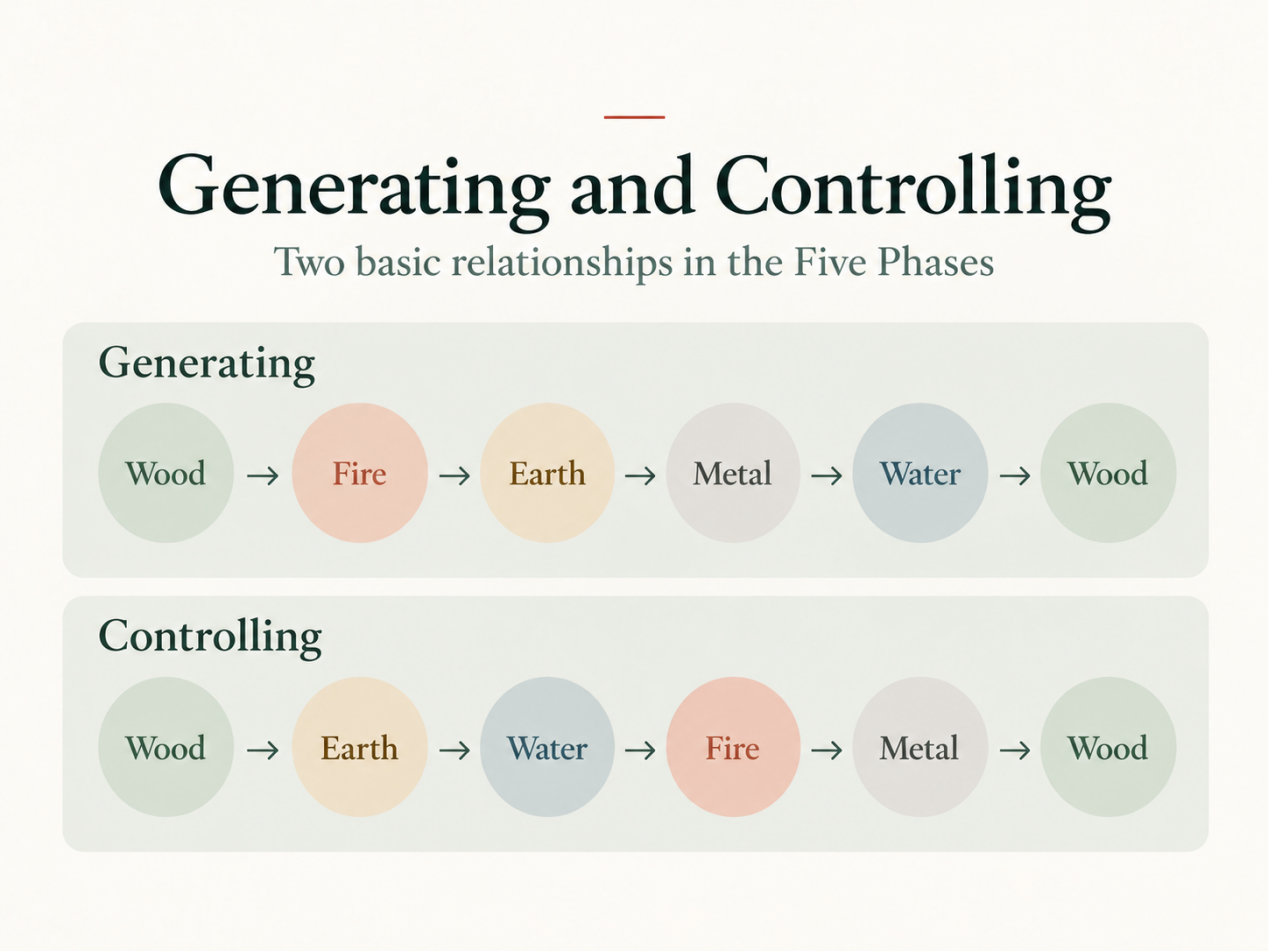
Wu Xing / Five Phases
How the Five Phases Generate and Control One Another in Traditional Chinese Medicine
Understand how the Five Phases generate and control one another in Traditional Chinese Medicine, with clear sequences and everyday memory images.
Read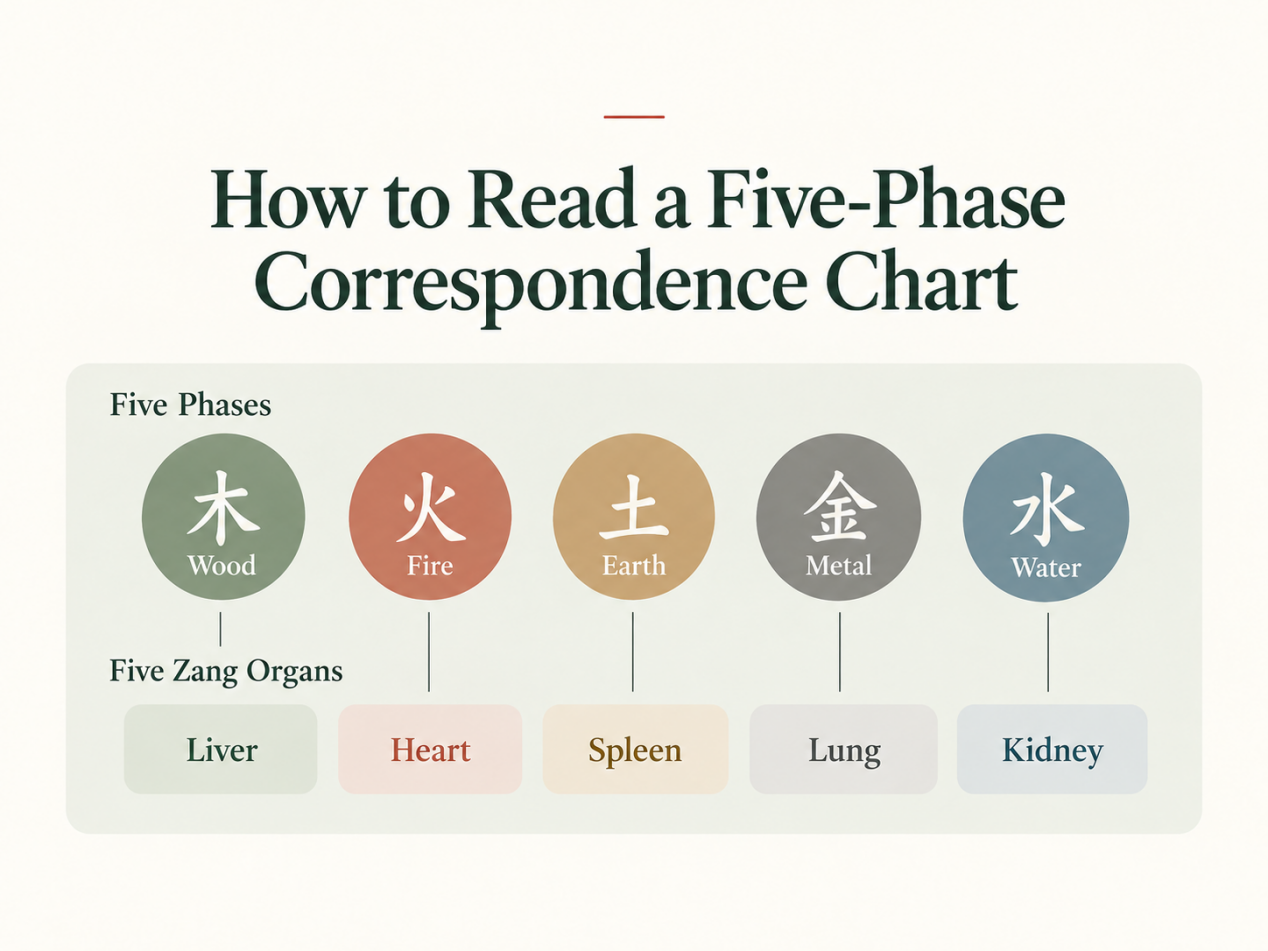
Wu Xing / Five Phases
How to Read a Five-Phase Correspondence Chart
Read two Five-Phase correspondence charts and understand how qualities connect Wood, Fire, Earth, Metal and Water with the body and natural world.
Read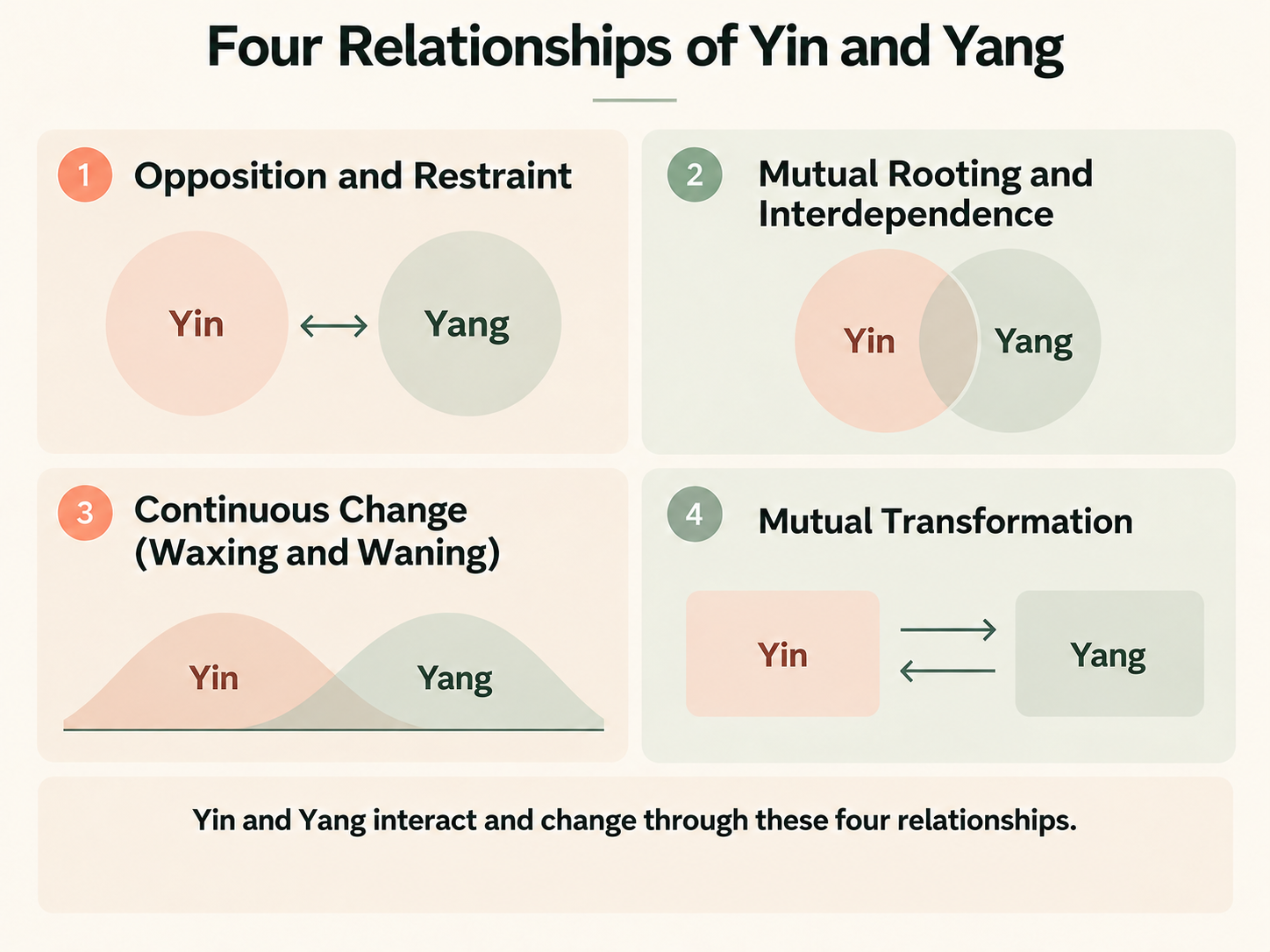
Yin & Yang
How Yin and Yang Relate: Four Core Relationships in Traditional Chinese Medicine
Understand four core Yin–Yang relationships in Traditional Chinese Medicine: opposition and restraint, interdependence, waxing and waning, and transformation.
Read
Seasonal Chinese Kitchen
One Passion Fruit, Two Autumn Recipes: Understanding Autumn Dryness and Body Fluids Through Everyday Chinese Food
Explore autumn dryness and body fluids in traditional Chinese food culture, with a warm passion fruit drink and passion fruit beef in sour broth.
ReadFor educational reading. This article does not provide individual diagnosis or treatment and is not a substitute for qualified professional care. Read the disclaimer.
Continue reading
How the Five Phases Generate and Control One Another in Traditional Chinese Medicine
The next question in the Wu Xing / Five Phases reading path.
Back to Wu Xing / Five Phases