
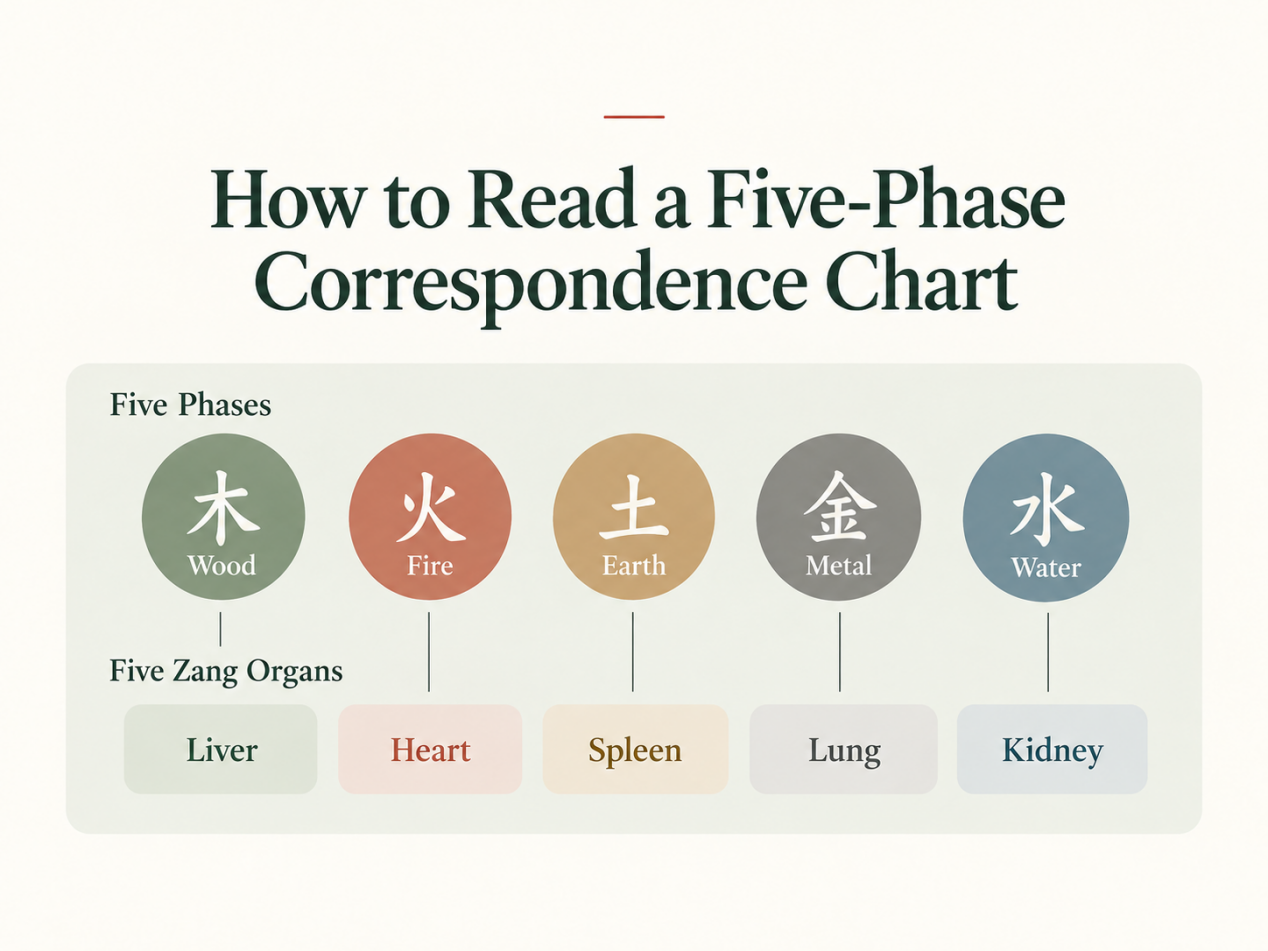
Start with these two charts.
| Phase | Zang Organ | Fu Organ | Body Tissue | Emotion | Voice | Sense Organ | Body Fluid | External Manifestation | Pulse | Change |
|---|---|---|---|---|---|---|---|---|---|---|
| Wood | Liver | Gallbladder | Sinews | Anger | Shouting | Eyes | Tears | Nails | Wiry | Grasping |
| Fire | Heart | Small Intestine | Vessels | Joy | Laughter | Tongue | Sweat | Face | Surging | Worry |
| Earth | Spleen | Stomach | Flesh | Pensiveness | Singing | Mouth | Saliva | Lips | Moderate | Retching |
| Metal | Lung | Large Intestine | Skin | Sadness | Weeping | Nose | Nasal Fluid | Body Hair | Floating | Coughing |
| Water | Kidney | Bladder | Bones | Fear | Groaning | Ears | Spittle | Hair | Deep | Trembling |
Numbers, trigrams and the Five Elements: explore their symbolic connections.
| Phase | Zang Organ | Color | Musical Tone | Taste | Transformation | Climate | Direction | Season |
|---|---|---|---|---|---|---|---|---|
| Wood | Liver | Blue-green | Jue | Sour | Emergence | Wind | East | Spring |
| Fire | Heart | Red | Zhi | Bitter | Growth | Summer Heat | South | Summer |
| Earth | Spleen | Yellow | Gong | Sweet | Transformation | Dampness | Center | Late Summer |
| Metal | Lung | White | Shang | Pungent | Gathering | Dryness | West | Autumn |
| Water | Kidney | Black | Yu | Salty | Storage | Cold | North | Winter |
Numbers, trigrams and the Five Elements: explore their symbolic connections.
These correspondences are part of a larger Five-Phase system that links patterns in the human body with patterns in the natural world.
At first glance, the charts can look overwhelming.
Do you really have to memorize all of this?
Not at once.
There is a much easier way in:
Some correspondences are easier to understand through their qualities. Others are first learned as a fixed sequence.
Start with one main axis:
Wood → Fire → Earth → Metal → Water
and match it with:
Liver → Heart → Spleen → Lung → Kidney
So:
Wood — Liver
Fire — Heart
Earth — Spleen
Metal — Lung
Water — Kidney
Once this axis is familiar, the other categories have somewhere to go.
Colors, tastes, seasons, directions, emotions, sense organs, tissues, and other correspondences no longer look like separate lists. They begin to form five groups.
But the chart is not random
The Five Phases are not simply five labels attached to unrelated things.
Each phase represents a group of qualities and patterns.
One way correspondences are formed is called 取象比类 (qu xiang bi lei): looking at the characteristic qualities, functions, or movements of something and comparing them with the qualities of the Five Phases.
Another is 推演络绎 (tui yan luo yi): once one relationship is established, related things can be connected through that relationship.
You do not need to memorize those terms yet.
Two examples make the idea much easier to see.
Why are Spring, Wood, the Liver, and the Sinews grouped together?
Wood is traditionally described with the phrase:
“Wood bends and straightens” — 木曰曲直.
Think of a living branch.
It can bend. It can straighten. It grows upward, extends outward, and remains flexible.
From this image, Wood came to represent qualities such as growth, rising, free flow, and ease of movement.
Now think about Spring.
After winter, plants begin to emerge again. Branches extend. New growth moves upward and outward.
That is why Spring belongs to the Wood group. Wood is associated with Spring, with growth and the beginning of upward movement.
Now look at the Liver.
In Traditional Chinese Medicine, the Liver is associated with rising and with keeping qi moving freely and smoothly. It prefers free movement rather than constraint.
These qualities correspond to Wood’s qualities of growth, rising, and free flow, so the Liver is classified under Wood.
Then notice one more connection: the Sinews.
The Liver is associated with the Sinews. The Sinews connect muscles and joints and help the joints move freely. When they are well nourished, movement is flexible and strong.
That gives us a useful image for remembering 曲直 — bending and straightening.
So one line of correspondence can be pictured like this:
Spring ← Wood → Liver → Sinews
Growth. Rising. Bending and straightening. Free movement.
Spring, Wood, the Liver, and the Sinews are not the same thing.
They are grouped together because they express related qualities and patterns of movement.
Why are Autumn, Metal, and the Lung grouped together?
Metal becomes easier to understand if you begin with Autumn.
In spring and summer, much of nature is moving outward: growing, expanding, flourishing.
Then autumn arrives.
The weather cools. Leaves begin to fall. The outward movement slows, and nature begins to gather inward.
This helps us picture several qualities associated with Metal: descent, contraction, and restraint. Metal is traditionally associated with sinking, gathering, and the movement away from outward expansion.
Autumn follows the same pattern.
Metal is associated with the West and with Autumn, a season characterized by a movement toward gathering and descent.
Now look at the Lung.
In Traditional Chinese Medicine, Lung qi has an important downward movement. The Lung is characterized by clearing and descending, and these qualities correspond to Metal’s qualities of clearing, contraction, and descent.
That is why the Lung is classified under Metal.
So:
Autumn ← Metal → Lung
Autumn, Metal, and the Lung are not the same thing.
They are grouped together because they share a similar directional pattern:
from outward expansion toward gathering, and from rising toward descending.
Two examples of how the chart works
Spring ← Wood → Liver → Sinews
growth · rising · bending and straightening · free flow
Autumn ← Metal → Lung
gathering · contraction · clearing · descending
Now look at the charts again
They should feel a little different now.
Some correspondences can be understood through shared qualities.
Others are easier to learn first as a fixed sequence.
And once one relationship is established, related ideas can be connected around it.
The chart is not simply a collection of facts to memorize.
It is a network.
You do not need to learn the whole network at once.
Start with:
Wood, Fire, Earth, Metal, Water
Then match:
Liver, Heart, Spleen, Lung, Kidney
After that, begin asking:
Why were these things placed in the same group?
That is the first step in learning how to read a Five-Phase correspondence chart.
But it also raises another question.
If the “Liver” is connected not only with the body, but also with Wood, Spring, the eyes, the Sinews, anger, and an entire network of correspondences, does “Liver” in Traditional Chinese Medicine really mean only the anatomical liver?
That is the question we will take up next.
In everyday life

Seasonal Chinese Kitchen
Chestnut Porridge: Why We Eat It When Winter Comes
From a familiar winter food to the TCM ideas of storing, the Kidney, and seasonal nourishment.
Read
Seasonal Chinese Kitchen
Why Do Chinese Families Make Osmanthus Pear Drink in Autumn?
An everyday Chinese drink, and the traditional ideas behind autumn dryness.
ReadFollow the connections
Wu Xing / Five Phases
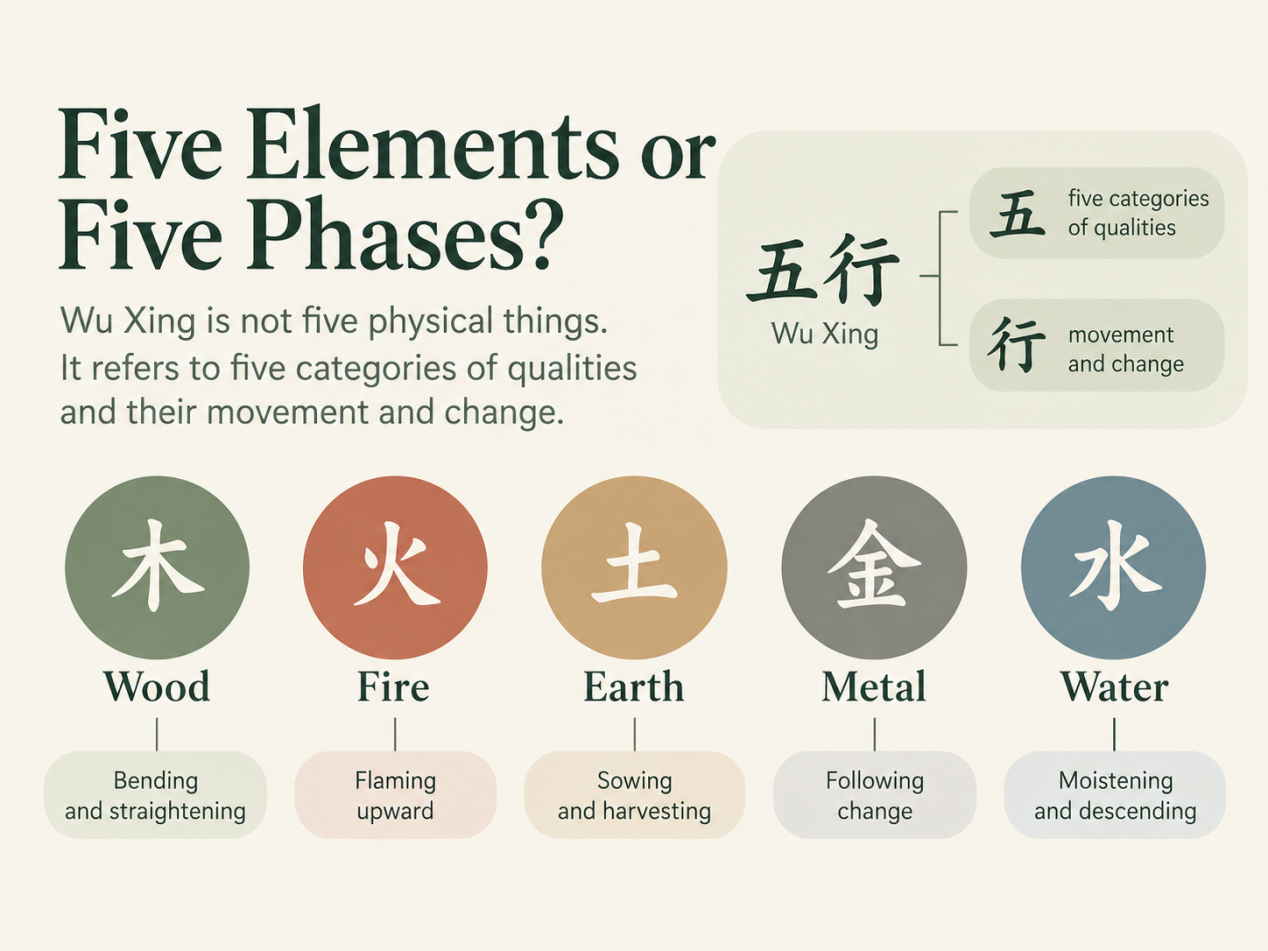
Five Elements or Five Phases? What Wu Xing Means in Traditional Chinese Medicine
Learn what Wu Xing means in Traditional Chinese Medicine through Wood, Fire, Earth, Metal and Water, their qualities, movement and change.
Read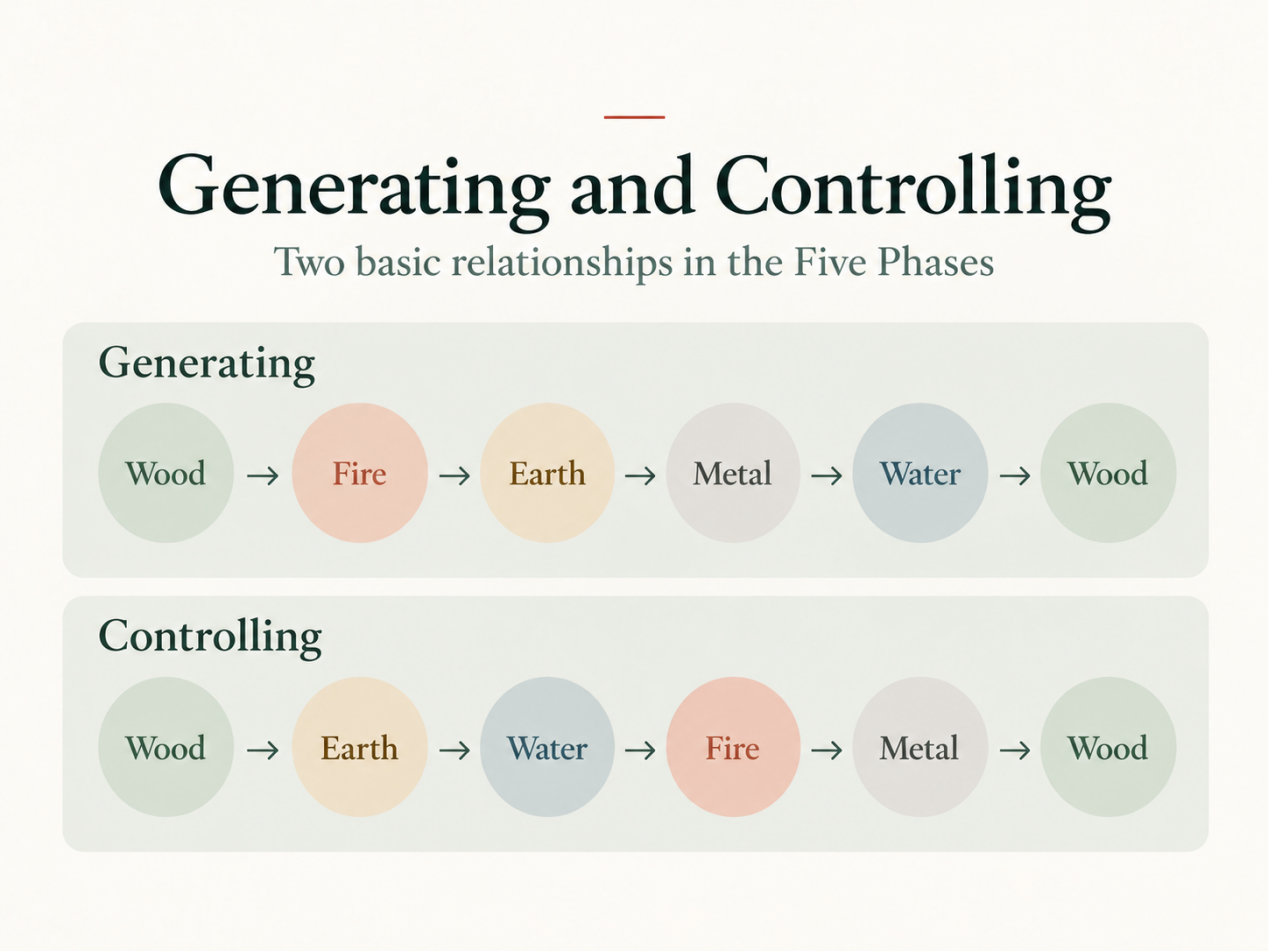
Wu Xing / Five Phases
How the Five Phases Generate and Control One Another in Traditional Chinese Medicine
Understand how the Five Phases generate and control one another in Traditional Chinese Medicine, with clear sequences and everyday memory images.
Read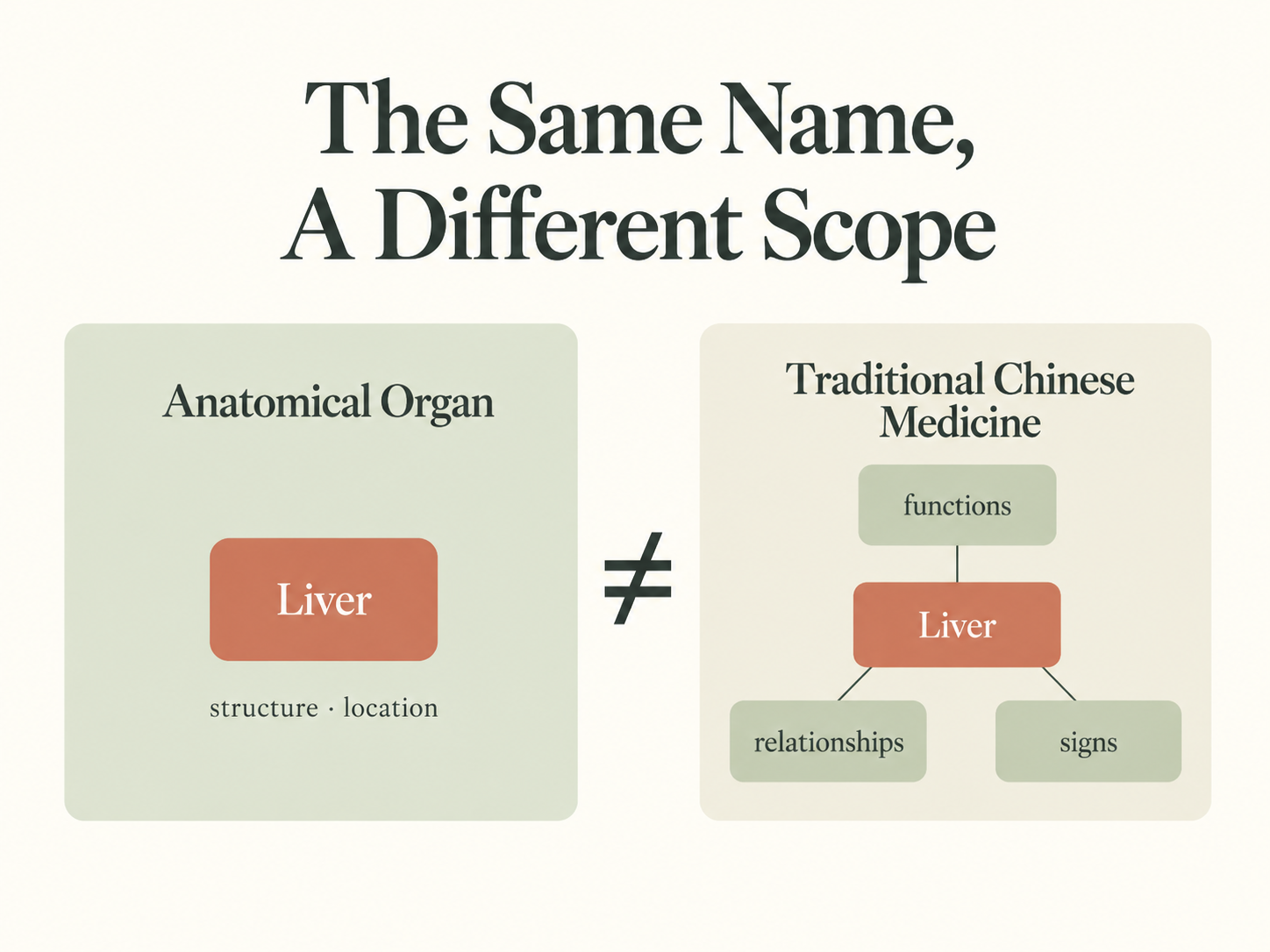
Zang-Fu: A Different Model of the Body
Why Traditional Chinese Medicine Organ Names Are Not the Same as Anatomical Organs
Learn why Liver, Heart, Spleen, Lung and Kidney in TCM refer to more than the anatomical organs with the same names, and how to read these terms in context.
Read
Seasonal Chinese Kitchen
One Passion Fruit, Two Autumn Recipes: Understanding Autumn Dryness and Body Fluids Through Everyday Chinese Food
Explore autumn dryness and body fluids in traditional Chinese food culture, with a warm passion fruit drink and passion fruit beef in sour broth.
ReadFor educational reading. This article does not provide individual diagnosis or treatment and is not a substitute for qualified professional care. Read the disclaimer.
Continue reading
Why Traditional Chinese Medicine Organ Names Are Not the Same as Anatomical Organs
The next question in the Wu Xing / Five Phases reading path.
Back to Wu Xing / Five Phases