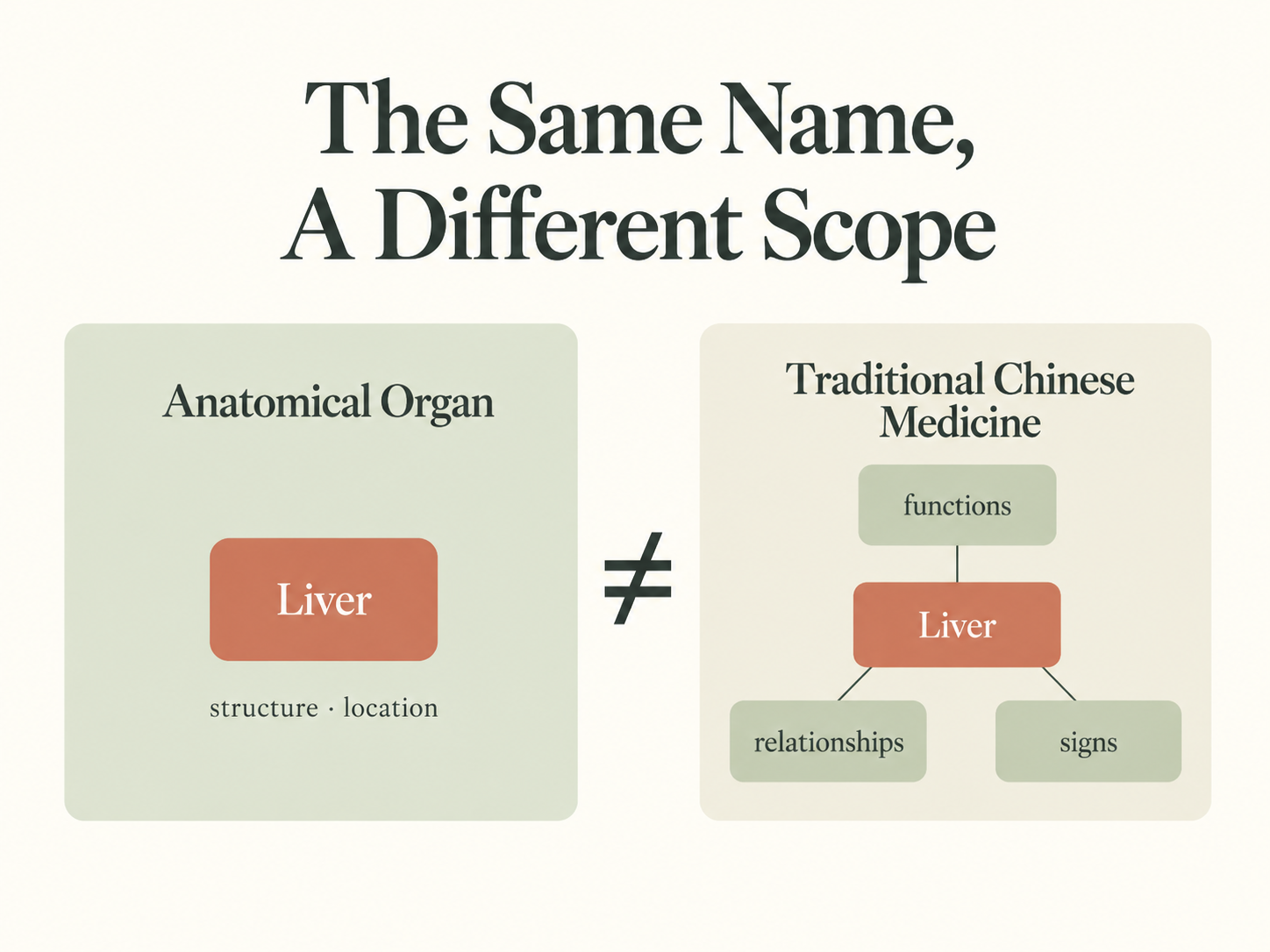
In the previous article, we looked at why organ names in Traditional Chinese Medicine do not refer only to the anatomical organs with the same names.
That leads naturally to two terms you will see again and again:
Zang and Fu.
What is the difference between them?
The simplest answer is this:
Zang and Fu are two different categories of internal organs in the traditional system, distinguished mainly by their characteristic functions.
Which organs are Zang, and which are Fu?
The five Zang organs are:
- Heart
- Lung
- Spleen
- Liver
- Kidney
The six Fu organs are:
- Gallbladder
- Stomach
- Small Intestine
- Large Intestine
- Bladder
- San Jiao
The purpose here is to understand why they are placed into two different groups.
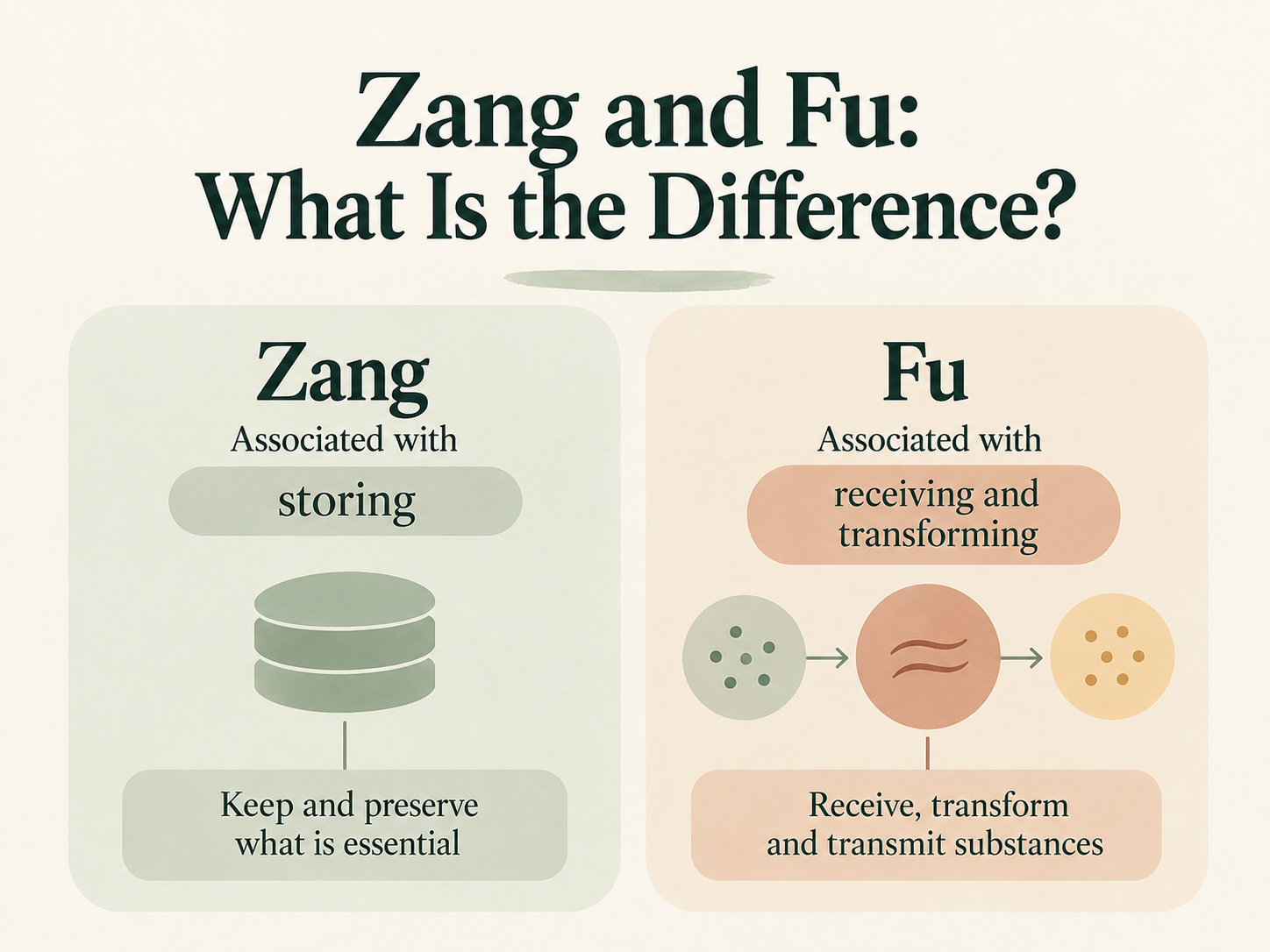
The key idea of Zang is storing
A traditional description of the Zang says:
They store essence and qi rather than discharge them.
The important word here is:
store.
As a group, the five Zang are associated with the generation and storage of essence and qi.
The Kidney provides a simple example.
The Kidney is traditionally said to store essence.
But the point of the example is not just the Kidney.
It is to show the broader pattern:
Zang are associated with storing and preserving what is essential.
That is the first half of the distinction.
The key idea of Fu is transmission and transformation
The Fu are described differently.
A traditional description says:
They transmit and transform substances rather than store them.
The Fu are associated with receiving substances, transforming them and moving them onward.
The Large Intestine gives a very simple example.
Its contents are meant to continue moving through the body rather than remain stored there.
The contrast can be stated simply:
Fu are associated more with receiving, transformation and passage.
This is a traditional functional description.
It should not be read as a modern biomedical explanation of digestion.
It is not simply “solid organs versus hollow organs”
You may sometimes see the distinction explained very quickly as:
Zang are solid organs, while Fu are hollow organs.
There is some reason this shortcut appears.
Traditional descriptions note that the five Zang are relatively substantial in form, while many of the Fu are hollow or tube-like structures.
But that is not enough to explain the classification.
As we saw in the previous article, Traditional Chinese Medicine organ concepts are not defined by anatomy alone.
So the more useful distinction is:
Zang → storing
Fu → receiving, transforming and transmitting
Anatomical form is part of the picture.
It is not the whole picture.
Why is the Gallbladder special?
The Gallbladder is included among the six Fu organs.
But it also belongs to another category called the extraordinary Fu organs.
This gives the Gallbladder a special position in the traditional classification.
The extraordinary Fu organs resemble Fu in form, but share with Zang the characteristic of storing rather than simply transmitting.
The full extraordinary-Fu category is beyond the scope of this article.
The Gallbladder is useful here because it shows something important:
Traditional Chinese Medicine does not classify internal organs by physical shape alone.
The categories also reflect how those organs are understood to function within the traditional system.
The distinction in brief
The distinction between Zang and Fu can be summarized in two ideas:
Zang → storing
Fu → receiving, transforming and transmitting
These two ideas capture the basic contrast between the two categories.
And one of the next questions is especially interesting.
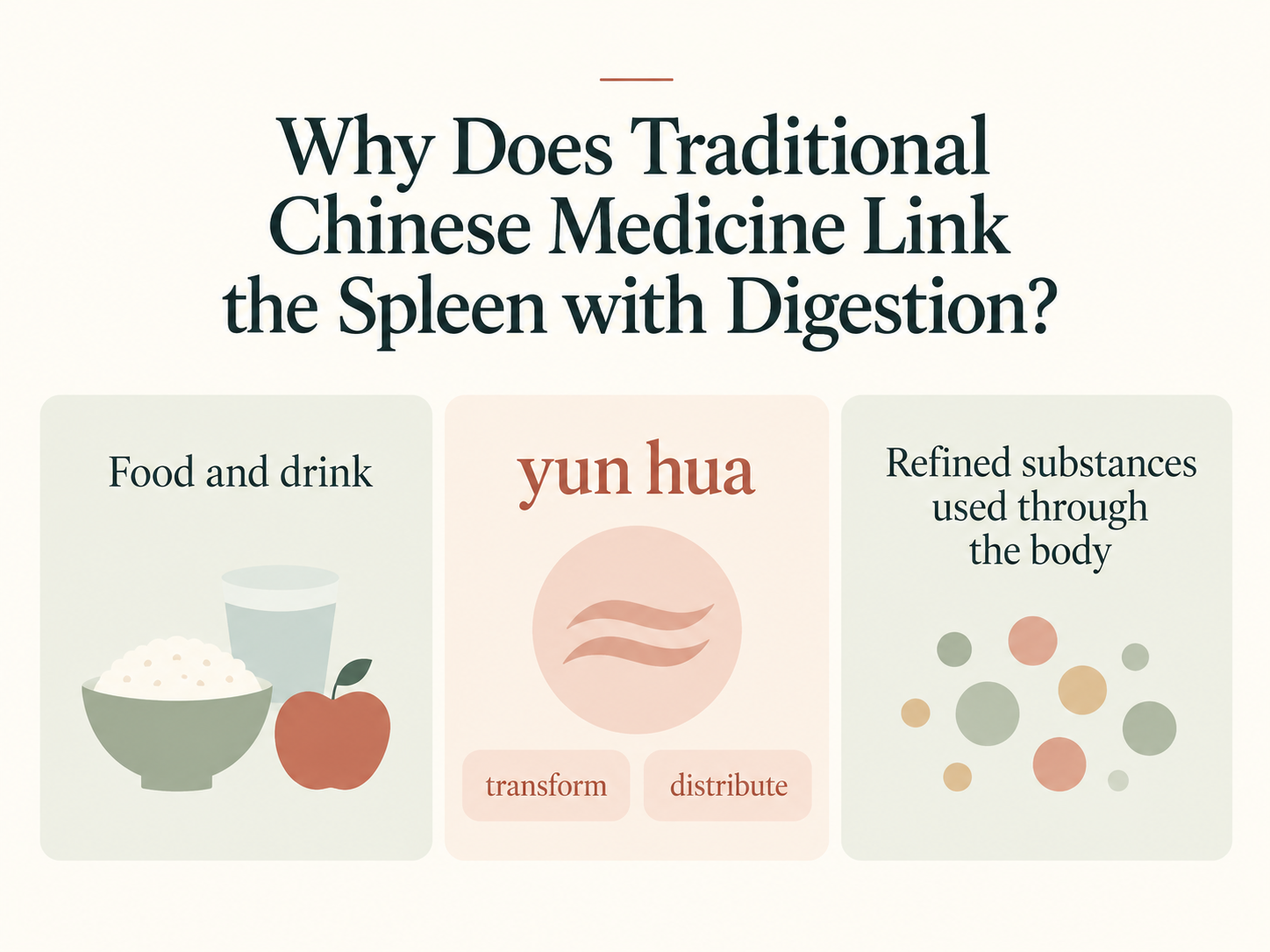
If the Spleen is called “Spleen” in English, why does Traditional Chinese Medicine connect it so closely with digestion?
That is what we will look at next.